
In my post on Smallest Shippable Value, I ended with this thought: “The REAL secret is finding those things that are the highest percent of the value that are worth shipping.” Optimized Shippable Value (OSV) is the formalization of that intuition.
SSV teaches us to break large features into smaller, deployable increments. But once you have those increments, which one do you ship first? OSV gives you a framework for answering that question.
To express this concept in a formula:
OSV = Value of Shippable Unit / Time to Value
Where:
Value of Shippable Unit– represents the perceived or actual value of the deliverable. This could be revenue impact, user satisfaction, strategic importance, or any other measurable metric.- Time to Value – represents the time (in appropriate units, e.g., hours, days) required to produce and deliver the product; expecting to see the increment value.
The higher the OSV, the more value is delivered per unit of development time.
An Example:
Let’s say your team is tasked with “Improving checkout conversion.” We’ve identified a few things we believe could increase conversion and have assigned Value as (potential increase in Revenue * likelihood it will work). Using SSV, you break it into four shippable increments:
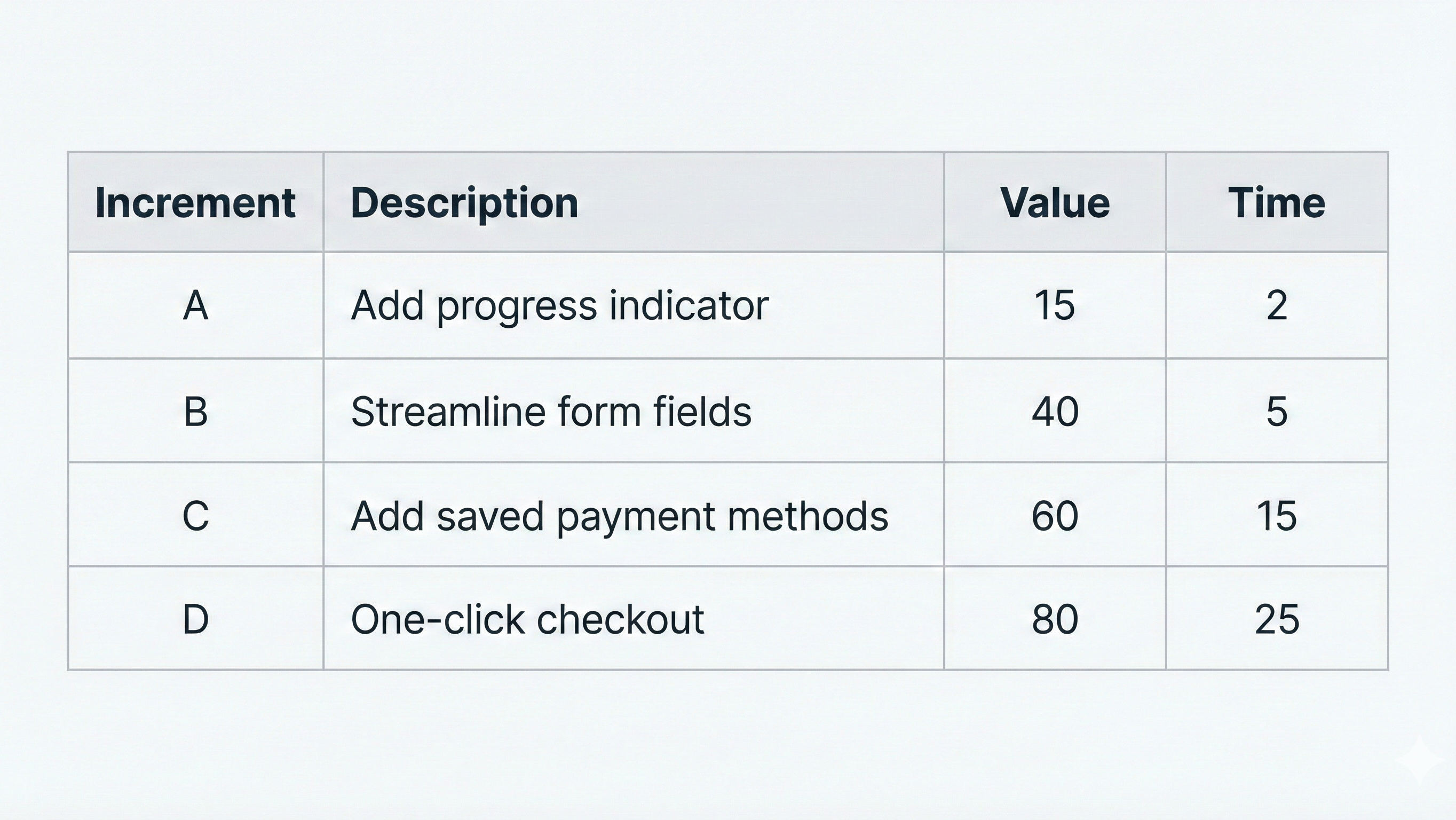
If you only looked at absolute value, you’d prioritize D (80 points) first. But D takes 25 time units — that’s a long wait before any value ships.
OSV suggests a different order: B → A → C → D

By shipping B first, you deliver 40 value points in just 5 time units. Then A adds another 15 in 2 units. By the time you’ve shipped B and A together, you’ve delivered 55 value points in 7 time units — nearly as much value as D alone, in less than a third of the time.
The insight: **SSV identifies the increments; OSV helps you sequence them.**
Using OSV
OSV is most useful when:
- You’re approaching a deadline and need to maximize delivered value
- You have multiple shippable increments competing for limited development time
- You’re deciding between a “quick win” and a larger feature
A few caveats:
- Value estimates are subjective. Don’t treat OSV as gospel — use it as a thinking tool to surface assumptions and drive discussion.
- Dependencies matter. Sometimes increment C requires A to be built first, regardless of OSV scores.
- OSV complements SSV, it doesn’t replace it. You need SSV to identify what’s shippable before OSV can help you prioritize.
The Takeaway
SSV breaks work down into shippable pieces. OSV helps you decide which piece to ship next. Together, they form a practical framework for maximizing the value you deliver per unit of development time.
The next time you’re staring at a backlog of features, try this: break each one into its smallest shippable increments, estimate value and time for each, calculate OSV, and let the numbers inform your prioritization. You might be surprised which increment bubbles to the top.


 Numbers & Nurture
Leave a comment